MONOBLOCK SYSTEMS SERIES
CE CERTIFIED
ISO 9001 CERTIFIED
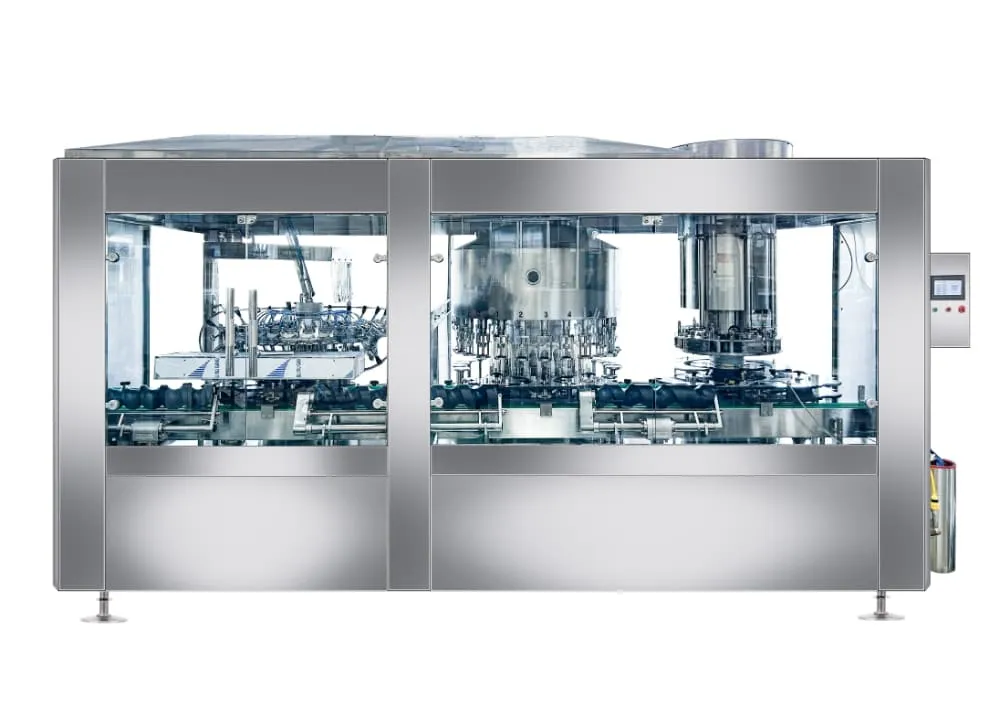
Monoblock for Rinsing, Filling & Capping
Our monoblock systems combine multiple key bottling steps into one coordinated machine platform, helping producers reduce transfer points, save floor space, and keep bottle handling more stable from infeed to discharge.
Built for non-carbonated liquid lines, this range covers rinsing-filling-capping, rinsing-filling-corking, and filling-capping configurations for wine, spirits, juice, oral liquid, and other bottled products that require cleaner process control and more efficient line integration.
Integrated Processing for Stable Bottling Output
Our monoblock systems are designed for producers who want a more compact, coordinated, and practical way to handle bottle rinsing, liquid filling, and final closure in one machine structure. Instead of relying on multiple disconnected units, this platform helps streamline bottle transfer and reduce process disruption between stations.
At MotivaPAC, we build these solutions around real production requirements, including bottle type, closure type, product category, target capacity, and plant layout. Backed by 20+ years of manufacturing experience, 18,000 m² of factory space, 12,000 m² of standardized workshops, advanced CNC machining capability, and ISO 9001 plus CE-certified production, we support both standard monoblock models and project-based customization.
Full-Process Monitoring During Filling
The filling section is designed with automatic monitoring logic that tracks bottle presence throughout the cycle, helping ensure no bottle, no filling and no bottle, no cap loading during operation.
The Solution:Supports more reliable bottle-by-bottle control in integrated bottling lines.
Servo-Synchronized Monoblock Control
Selected models use advanced servo transmission with PLC-linked section control, allowing filling and closure actions to run in coordinated sequence for more stable automatic production.
The Solution: Keeps multi-step bottle handling more synchronized across complete bottling cycles.
Lower Friction, Higher Efficiency
Because key bottling steps are arranged in one integrated machine and bottle lifting motion is reduced on relevant models, mechanical friction and power loss are lowered during continuous production.
The Solution:Helps factories run compact bottling operations with better energy efficiency.
Fast Filling with Reduced Drip
On relevant models, non-contact quantitative filling, dual-cylinder control structure, and variable-speed filling help maintain higher filling speed while reducing overflow during filling and drip after discharge.
The Solution: Improves filling stability where speed and bottle presentation both matter.
Stable Operation for Everyday Production
Our monoblock systems are designed for practical plant operation, combining coordinated bottle transfer, stable filling control, and dependable downstream sealing or corking performance in one machine frame.
Electric Height Adjustment for Faster Changeover
Selected monoblock models support electric height adjustment with one-touch operation, making it easier to adapt to bottles within the specified height range and shorten changeover time between bottle formats.
Bottle-Friendly Handling with Soft Motion Control
Variable-frequency speed control, soft start, soft brake, automatic bottle height adaptation, and overload protection help reduce rigid impact and lower the risk of bottle damage during continuous production.
Reliable Sealing and Corking Structures
The capping section on relevant models uses a four-spring capping head structure for more even force application and better sealing consistency, while corking configurations add no-bottle-no-cork logic to reduce material waste.
Why Bottling Producers Choose Our Monoblock Systems
For many glass-bottle and non-carbonated liquid lines, bottling efficiency is not only about output. It is also about steadier bottle transfer, cleaner filling, reduced drip, reliable sealing, and simpler layout planning.
Cleaner
Integrated monitoring and no-drip logic help reduce visible spillage before labeling or packing.
Smaller
Combining multiple steps into one unit reduces separate-machine transfer zones and layout pressure.
Smarter
Rinsing, filling, capping, or corking are matched inside one system to improve process continuity.
Monoblock Systems Technical Specifications
Below are representative standard models from our monoblock systems range, covering filling-capping, rinsing-filling-capping, and rinsing-filling-corking configurations for different output levels and closure styles.
| Model | Configuration | Capacity (b/h) | Filling Type | Heads / Stations | Application Notes |
|---|---|---|---|---|---|
| GF12-10 | Filling + Capping | 5000-12000 | Piston quantitative filling | 12 filling / 10 capping | For 30-100 ml straight oral liquid bottles, ±1.5% |
| GF18-4 | Filling + Capping | 4500 | Intelligent filling valve | 18 filling / 4 capping | Compact fill-cap platform |
| GF48-16 | Filling + Capping | 12000 | Intelligent filling valve | 48 filling / 16 capping | Higher-output integrated filling and sealing |
| GF72-20 | Filling + Capping | 18000 | Intelligent filling valve | 72 filling / 20 capping | Large-output dual-unit style configuration |
| QGX16-16-1 | Rinsing + Filling + Capping | 2000 | Low vacuum filling | 16 rinsing / 16 filling / 1 capping | Entry-level 3-in-1 platform |
| QGX24-24-4 | Rinsing + Filling + Corking | 5000 | Low vacuum filling | 24 rinsing / 24 filling / 4 corking | Mid-speed corking line |
| QGX24-24-8 | Rinsing + Filling + Capping | 6000 | Low vacuum filling | 24 rinsing / 24 filling / 8 capping | Mainstream rotary monoblock output |
| QGX40-40-12 | Rinsing + Filling + Capping | 12000 | Low vacuum filling | 40 rinsing / 40 filling / 12 capping | Higher commercial throughput |
| QGF24-24-6 | Rinsing + Filling + Corking | 5000 | Low vacuum filling | 24 rinsing / 24 filling / 6 corking | Wine and similar glass bottle lines |
| QGF32-32-12 | Rinsing + Filling + Capping | 8000 | Electronic quantitative filling | 32 rinsing / 32 filling / 12 capping | Higher-end monoblock configuration |
| QGD16-16-1 | Rinsing + Filling + Corking | 2000 | Low-vacuum negative-pressure filling | 16 rinsing / 16 filling / 1 corking | Corked bottle applications |
| QGD24-24-6 | Rinsing + Filling + Corking | 5000 | Low-vacuum negative-pressure filling | 24 rinsing / 24 filling / 6 corking | Mid-speed corking production line |
Typical Applications: What Are Our Monoblock Systems Best For?
Our monoblock systems are built mainly for non-carbonated bottled liquids that need integrated rinsing, filling, and closure handling in one coordinated machine layout.
Wine, Spirits & Glass-Bottle Liquids
Rinse-fill-cork and rinse-fill-cap configurations are suitable for wine, liquor, fruit wine, and other glass-bottle liquid lines where bottle handling stability and sealing quality are both important.
Juice, Beverage & Non-Carbonated Products
Integrated rinse-fill-cap monoblocks are suitable for non-carbonated beverages and similar bottled liquids that need stable filling, liquid-level consistency, and more efficient rotary processing.
Oral Liquid & Small-Volume Bottle Packaging
Track-style fill-cap machines such as the GF12-10 configuration are suitable for 30 ml, 50 ml, and 100 ml oral liquid style filling where compact integrated sealing and higher speed are required.
Tailored to Your Needs: Monoblock Line Support & Customization
At MotivaPAC, we support monoblock planning not only as standard machine selection, but also as part of full line design around bottle type, closure style, target capacity, and downstream packaging requirements.
Choose the Right Configuration by Process
Select filling-capping monoblocks when your process starts after bottle preparation, or choose rinsing-filling-capping / rinsing-filling-corking systems when you want more process integration.
Choose the Right Model by Throughput
From compact 2000 b/h configurations up to higher-output 12000 b/h and 18000 b/h systems, the monoblock range covers small, medium, and larger bottling projects.
Connect with Upstream & Downstream Equipment
These systems can be planned with upstream bottle preparation and downstream drying, labeling, packing, and other liquid packaging equipment to build a more complete bottling line.
Adapt to Bottle and Closure Requirements
Bottle diameter, bottle height, filling volume, closure format, and target output all affect the final selection. We help align machine structure with your actual packaging requirement instead of forcing one format into every project.
Frequently Asked Questions About Our Monoblock Systems
Expert answers to your technical and operational queries.
A fill-cap monoblock combines filling and capping in one machine, while a rinse-fill-cap monoblock adds bottle rinsing before filling. For corked bottle applications, rinse-fill-cork structures are also available.
They are mainly used for non-carbonated liquid products such as wine, spirits, juice, beverage liquids, oral liquids, and other similar bottled solutions.
Representative rinse-fill models are suitable for bottle diameters around 60–100 mm, bottle heights around 220–350 mm, and filling volumes around 100–1500 ml.
For the rinse-fill monoblock range, listed liquid-level filling accuracy is around ±2 mm. For the GF12-10 oral liquid fill-cap monoblock, listed filling accuracy is ±1.5%.
Yes. The monoblock range includes no bottle no filling logic, and on relevant configurations it also includes no bottle no cap loading or no bottle no corking logic.
Yes. We support integrated liquid packaging line planning based on bottle type, liquid category, target capacity, closure format, and downstream packaging requirements.
Ready to Upgrade Your Bottling Line with a Monoblock System?
Tell us your bottle type, product category, closure style, and target output. We can help you match the right monoblock configuration for your project, from compact fill-cap units to larger rinse-fill-cap or rinse-fill-cork systems.